Tag Archives: Schools

European Commission scolds Hungary

Published by:

European Commission scolds Hungary

The European commission scolded Hungary for having segregated schools for Rroma which violate the EU directives on Rroma integration. Hungary has now some time to remedy the situation. Let’s see…

Well done and about time!

School and Rroma: A trial in France

Published by:

Another report on the trial of a French mayor (we reported a while back) of the town of Sucy en Brie who was accused of having denied 5 Rroma children their right to education. The mayor was cleared of all charges, but the fact remains that Rroma children, without a formal housing document, as often denied education, in spite of French law.

A shame.

Schools, children, expulsions …

Published by:

Schools, children, expulsions …

Meanwhile in France, the usual expulsions, defence, squats still make the headlines. In the University of Paris 8, the right for children to go to school is at the centre; in Ivry, near Paris, 73 families have to leave their camp; in the South West, two families are also expulsed; while in the Paris region, tensions are reported near a Rroma camp.

French Mayor accused discrimination

Published by:

French Mayor accused discrimination

The mayor of Sucy-en-Brie Marie-Carole Ciuntu was accused of discrimination for having refused to enrol 5 Rroma children in school ass they did not have a proper “attestation de domicile”, a proof of residency. The mayor was cleared in court.

Meanwhile in France …

Published by:

Meanwhile in France …

In France, the summer is the season for expulsions. The reason being that the arguments that children are in school do no longer work due to the fact that the summer holidays have started.

Amnesty reports on this and the general issue of children in Ivry, and in Ris-Orangis in Evry, both near Paris. The last locality, Evry was the municipality that refused burial to a Rroma child a while back, something that is noted in Liberation as being an attack against Rroma. Other news contain the fact that Rosny and Montreuil, near Paris refuse the installation fo Rroma; that in Grenoble, on the initiative of the church and Rroma, a dinner was organised between the two communities; while in Wissous, the situation is getting tense a month after a judge ordered the expulsion.

Children are victims of evictions

Published by:

Children are victims of evictions

The newspaper “Le Monde” published two articles on the fate of Rroma children who live in camps are are often the victims of the forced evictions that are the norm under the current government of Valls. For the children, it often means stopping going to school and thus, another failed integration.

Film on a Rrom who wants to become a teacher

Published by:

Film on a Rrom who wants to become a teacher

An Al-Jazeera film shows the quest of a 30 years old Rrom from a ghetto who, after a beating by the police, decides to finish high school and to become a teacher. While the story is definitively worthwhile and the man’s determination is to be really admired, the film and the article on it serves all the commonly held stereotypes. Broken families, criminality, drugs, etc. A more differentiated view is seldom presented in the press.

European Commission against Slovakia

Published by:

European Commission against Slovakia

The European Commission (EC) has started a legal action against Slovakia on the basis of the ongoing discrimination against Rroma children in that country. The EC says that a unusually high number of Rroma are placed in schools for mentally disabled children, a practice that is ongoing since the 1950’s in that country. Well Done for the EC, Shame on Slovakia. Especially since the government states that this high number is due to Rroma incest .

Fighting school segregation

Published by:

Fighting school segregation

An interesting article on the various ways to fight school segregation in the case of Rroma in Europe. School segregation is too often still the norm, especially in Hungary, Slovak and the Czech republic, as well as in Romania.

Bulgaria: A hard life for girls

Published by:

Bulgaria: A hard life for girls

An article on the Rroma Mahala in Vidin, in North Western Bulgaria. The article, while dispelling some of the stereotypes of many children, still pushes some age old prejudices, stating that marriage occurs by abduction (ritually, yes, practically, unknown), that child brides are the norm etc. What most journalists tend to blend out is that in Rroma tradition, one is married if one sleeps with one’s boyfriend. So effectively, by this standard, most of girls in Western Europe are not that different … What is different tough is that there is little contraception, resulting in early pregnancies, dropping out of schools, etc. All things that are a social poverty issue and have de facto nothing to do with Rroma.

European Commission slams Slovakia

Published by:

European Commission slams Slovakia

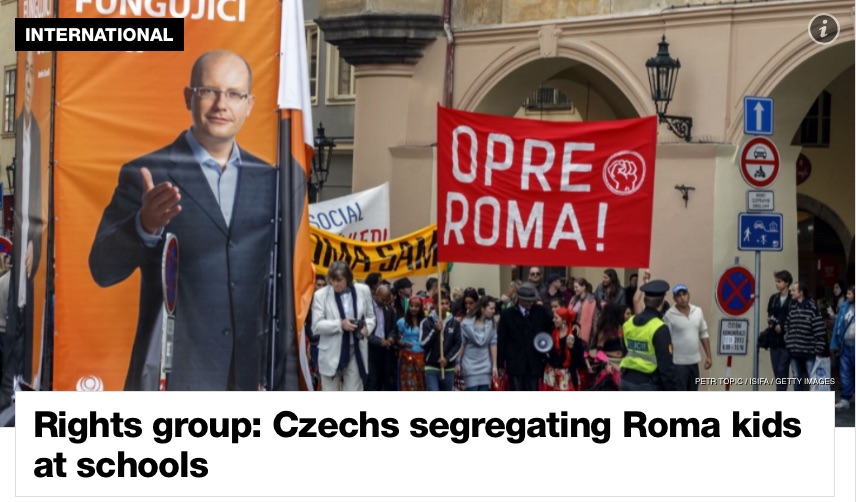
The European Commission criticised Slovakia for systematic discrimination of Rroma children in education. It started legal proceedings for breaches of EU anti-discrimination law, referring to discrimination against Roma children in education. After the Czech Republic where such a procedure was started in September 2014, this is the second country in Europe that is being targeted.

Segregation in schools has been common in both the Czech and Slovak republics, but also exists in Romania and in Hungary. The practice of sending Rroma children systematically to schools for mentally disabled people is unfortunately also part of this pattern.

We welcome these actions!

Amnesty International condemns the Czech Republic for segregation

Published by:

Amnesty International condemns the Czech Republic for segregation

alJazeeraAmnesty International condemned the fact that the Czech Republic has failed to comply with a European court order to stop placing Roma children in schools for the mentally disabled regardless of the students’ capabilities. Placing Rroma in schools for mentally disabled people has a long tradition in the Czech and Slovak republics as well as in Hungary and Romania. This is simply no longer acceptable in the 21. Century.

Hungary: Rroma only schools

Published by:

The Hungarian supreme court allowed Rroma only religious schools in that country. The Hungarian minister for Education, Integration, and Human resources had been supporting the views from the schools who had lost a case in lower instances. The EU and the Chance for Childrne Foundations were clearly against it.

So are we… Segregation on any reason is not an answer. The answer is integration.

Amnesty International slams segregation of Rroma in schools in Slovakia

Published by:

Amnesty International slams segregation of Rroma in schools in Slovakia

Three years ago, a landmark judgement found that Slovakia was discriminating Rroma children with the practice of having segregated schools. A report from Amnesty International reveals now that the situation has far from improved. This is due to the introduction of so-called “container schools” are installed in predominantly Rroma settlement, and are attended exclusively by Rroma children, the non Rroma population preferring to send their children to other schools. This is no longer segregation, this is total isolation …

Černušáková, Barbora. Slovakia’s ‘container schools’ worsen segregation of Roma children from society. In: Amnesty International Blog. 13.03.2015. https://www.amnesty.org/en/articles/blogs/2015/03/slovakia-segretation-of-roma-schoolchildren-worsens/

08.02.2015 Remembrance of victims of the Holocaust

Published by:

HNA reports on the research of a history teacher, Arndt Böttcher, who has been researching the history of a Rroma family in Battenberg, the Klein. The family settled in Battenberg in the 18th century and was deported to Auschwitz and other camps during the war. Many died but apparently 4 sons survived the horrors of the war.

05.12.2014 Halle: persistent aggressions towards Rroma

Published by:

Neues Deutschland (2014) reports on ongoing pogroms and incitement against Rroma in Halle. In the recent months, repeated assaults against Rroma occurred in the quarter of Silberhöhe. Moreover, xenophobic Facebook groups called for violence against the minority. Silberhöhe is a poor district, which is characterised by industrialised apartment blocks: “The attackers were between 10 and 13 years old. In mid-September, a young Roma woman and her two-year old son were attacked by adolescents in Silberhöhe, an industrialised building quarter in Halle. […] The instigators however, are adults. They operate Internet sites such as “hallemax.de”, where in hard tone and partly with multiple entries a day, one speaks about “alienation” and against Rroma. […] The focus of their aggression is a group of 40 families, belonging to the Roma minority, who immigrated from Romania and Spain – in the context of the EU-wide freedom of movement. From the beginning, the newcomers were faced with dislike, aggression and hatred. Especially the children reported bullying on the street or in the supermarket, the mobile victim counselling of Halle states. Later, a so-called “vigilante group” was founded, who was supposed to ensure “peace and order” with patrols in Silberhöhe.” In response to the xenophobic actions, a group against anti-Semitism was founded. The alliance “Hall against right-wing extremism” organised counter-demonstrations to the hostile actions against Rroma, in order to express their solidarity with the minority and to stand up against anti-Semitism. In addition, a meeting was organised to counter the prejudices against immigrants with facts and  knowledge. In Germany, there are an estimated 110,000 to 130,000 Rroma, many of them for generations. They are integrated, go to work, speak German and send their children to school.

05.12.2014 Bron: Mrap criticises planned segregated class for Rroma children

Published by:

Bevand (2014) reports on the latest matter of the French movement against racism (Mrap). The organisation criticises the decision of the mayor of Bron, to set up an extra class for Rroma children in the community. The class is supposed to encompass the children of a local Rroma settlement and to include Rroma children already enrolled in school. The movement against racism justifiably criticises that the children are thereby intentionally excluded and disadvantaged: “Towards a new controversy? In any case, the movement against racism and for the friendship between people (Mrap) condemned in a statement on Monday the decision of the mayor of Bron – a statement near Lyon – to open an “ethnic class” to receive the Roma children of a local slum. […] Without distinction, it groups together children who were already enrolled in previous years and speak French well, with other children who have just arrived in France, MRAP continues, which wants “to invoke the defenders of rights to finish this additional ethnic segregation.” Segregation is inevitably the wrong way to promote the integration of migrant children. Rather, it promotes the exclusion and marginalisation of the children as well as the immigrant families. As Bevand himself points out, so far, children with weak knowledge of the French language were additionally supported, but could attend regular classes. This is a much more elaborate method, which aims at integration and support, and not to at a special treatment and exclusion. – According to estimates of the Rroma Foundation, in France there are between 100,000 and 500,000 Rroma. The vast majority of them is integrated, goes to work, and sends their children to school. The estimated 15,000 Rroma living in informal settlements are a minority of the minority.

05.12.2014 “Roma does not equal poverty migration”

Published by:

Selke (2014) spoke with Prof. Max Matter, a Swiss folklorist, about his new publication “Nowhere Desired: Poverty migration from Central and Eastern Europe into the countries of the EU-15, with particular reference to members of the Roma minority”. In his book, Matter addresses the mixing of prejudices with ethnic ascriptions and political viewpoints. Many politicians and journalists used the term “poverty migration” as a synonym for the migration of poor Rroma to Western Europe. With the expansion of the free movement of persons to Romania and Bulgaria, one increasingly spoke about well educated Romanians and Bulgarians, who also migrate to Western Europe. However, opponents saw this argument as trivialising the real situation. In his publication, Matter tries to deconstruct reductionist ascriptions that portray Rroma as poor travelling beggars: Rroma are not a homogeneous mass, are mostly sedentary since centuries and have no kings. In addition, many other ethnic groups also migrate to Western Europe. The assertion of a “mass immigration into the German welfare system” is not supported by the facts: “According to the Institute for Employment Research, there are just over 500,000 people from Bulgaria and Romania in Germany. As I said, some have very good school and vocational qualifications. Many of them work. All of them counted together, they just constitute six per mil of the German population. Therefore, one can hardly speak of a mass immigration into the welfare system.” Matter also refers to the majority of well-integrated Rroma that have been living integrated in Western Europe since generation and speak the local languages. At a meeting of scientists and politicians on December the fist in Berlin, the majority of those present demanded a de-dramatization and objectification the debate on “poverty migration”: There is no widespread welfare fraud. The existing social problems are not the result of immigration, but problems already existing before. In addition, one should be cautious with the use of ethnic attributions (compare Bade 2014 MiGAZIN 2014).

05.12.2014 Integrated Rroma in Germany

Published by:

Jaeger (2014) spoke with Sonja Böttcher, a German social worker and Rromni. The 43-year-old is the daughter of Hans-Georg Böttcher, one of the founders the Roma Union. Böttcher talks about persistent prejudices against the minority, Rroma living integrated and the importance of being able to accept ones’ identity in spite of prejudices: “There are deeply rooted prejudices against Roma. That they are dirty and mostly homeless, depraved. However, most people do not even know Roma.Changes and positive examples are not perceived. Many Roma are indeed born here and have respected professions. […] But we live in a time, where the origin does actually not matter anymore. Therefore, I would like to see a stronger voice in the community. This may help to eliminate clichés. For a long time, I have denied my origins and told that I am from India […]. And based on my experience, I can say today that there is no reason to deny oneself. I actually think that it is time that we should go into the offensive.” In Germany, according to assessments of the Rroma Foundation, there are an estimated 110,000 to 130,000 Rroma. The majority of them is integrated, works, speaks German and sends their children to school. They are proof that integration is possible. Rroma belong to all social strata and professions. On the occasion of the debate about the so-called “poverty immigrants”, a highly biased notion of the minority was spread which discredits the majority of integrated Rroma. In an article of December 2nd, Jaeger (2014/II) himself points out to the problems of overcrowded house, into which Rroma families moved. The inhabitants of the overcrowded apartments will be allocated alternative accommodation. Nevertheless, the one-sided coverage of Rroma is not discussed (compare Jaeger 2014/III).  

rroma.org
en_GBEN