Category Archives: News Switzerland

Romania: Between poverty and the hope of integration

Published by:

Romania: Between poverty and the hope of integration

Swissinfo reports on Swiss help for Rroma in villages in Romania and on the fact that the Swiss government is making Rroma a priority for their foreign aid, especially to Romania and Bulgaria.

The report focuses on an initiative of Terre des Hommes, funded by the Swiss government in several villages in South Western Romania.

Amnesty: Who are Rroma

Published by:

Amnesty: Who are Rroma

amnestyAmnesty wrote a FAQ sheet on Rroma. Not bad, but still perpetuating some stereotypes. Rroma “travelled from place to place”. This is clearly false in many places, in the Balkans but also in Western Europe. Pity that they couldn’t get over their stereotypes.

More Minority Status in Switzerland

Published by:

More Minority Status in Switzerland

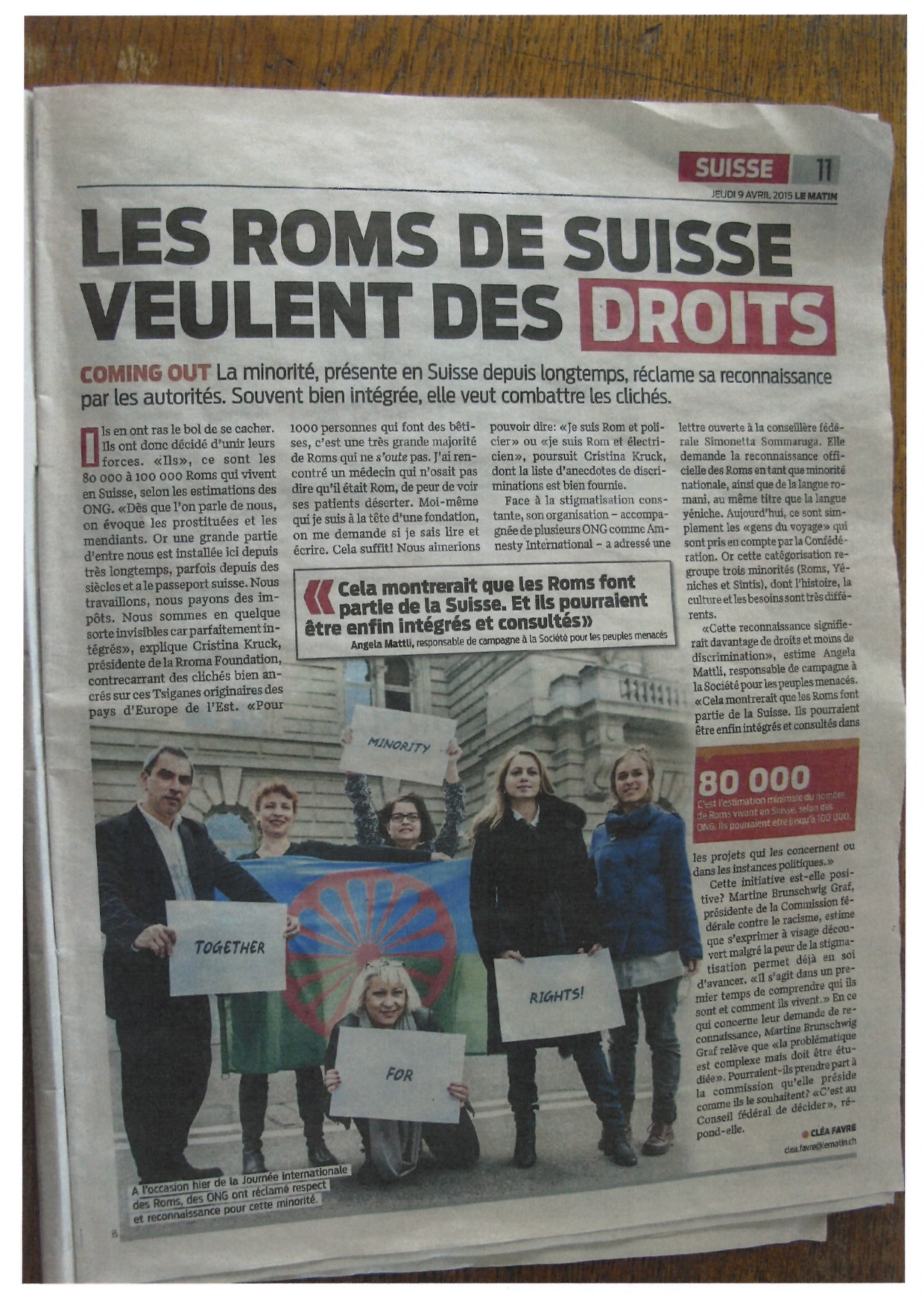
Several French speaking newspapers in Switzerland published a common article on the open letter of Rroma, Sinti, and Jenische organisations to Ms. Sommaruga, the president of the Swiss confederation, appealing for recognition as a minority in that country.

While we greet the fact that these papers who normally only publish news of stealing, begging, or whoring Rroma, effectively stated that there are 80 to 100 thousand integrated Rroma in the country, we find it less amusing that none of the organisations they cited as co-signatories of the open letter are Rroma NGOs, and indeed they signed. In addition, several of the papers still resorted to the good old clichés of caravans, poverty, and other stereotypes when setting the picture.

Switzerland: Rroma ask for minority status

Published by:

Switzerland: Rroma ask for minority status

The Neue Zürcher Zeitung reports on an action of Rroma, Sinti and Jenische representatives who wrote a letter to the President of the Swiss Confederation, Ms. Sommaruga asking for formal recognition of the Rroma as a minority in Switzerland. The paper notes that the up to 100 thousand Rroma living in that country are well integrated, but are not represented in several state organisation, for example in the Swiss Federal Commission against Racism.

20 minutes in Switzerland: Authorities know too little on Rroma

Published by:

20 minutes in Switzerland: Authorities know too little on Rroma

20 Minutes reports on the fact that Rroma, Sinti, and Jenische, on the occasion of the International Rroma Day on April 8th, have written a letter to the President of the Swiss Confederation, Ms. Sommaruga, asking for an explicit recognition of the minority in Switzerland. The article stresses that the 80 to 100 thousand Rroma living in Switzerland are well integrated and mostly Swiss.

Switzerland: No space for foreign travellers

Published by:

The camping place for travellers in Winterthur is now closed to foreign travellers. Official reason given is that a while back, some travelling Rroma left the place in dire state. Hence the interdiction.

That the behaviour of a few people should not be taken as grounds for a blanket interdictions should have occurred to the city of Winterthur… This is simply not acceptable in the 21st century.

A movie on Rroma beggars in Lausanne

Published by:

A movie on Rroma beggars in Lausanne

Another documentary on Rroma beggars in Switzerland. It is amazing how a very small number of people seems to fascinate an entire country. In Lausanne, there are no more than 60 beggars at any time, and not all of them are Rroma. In Switzerland, there are at most 1’000 such beggars, thieves, prostitutes, and they are represented as a horde invading this peaceful country… Even theough there are 80 to 100 thousand well integrated Rroma there.

In Brief, another movie, another view on the same old stereotypes.

The French speaking Swiss press equates Rroma with poor migrants

Published by:

The French speaking Swiss press equates Rroma with poor migrants

The newspaper “La Liberté” in a series of recent articles equates Rroma with poor migrants who come to Switzerland to beg. There is no differentiation, and the implicit ethnicisation of a social problem and the projection thereof on all Rroma is simply not acceptable.

They also mention the exhibition from Yves Leresche, a photographer who has captured many shantytowns and who shows the poor face of Rroma. All in all, this re-inforces the negative views that are already prevailing among the general population.

When one thinks that all the beggars, prostitutes and thieves in Switzerland number less than a thousand, which is not even 1.5% of the Rroma population of the country, one sees how far these views are from reality.

22.02.15 Rroma, these unknown people whom we love to hate

Published by:

22.02.15 Rroma, these unknown people whom we love to hate

In Geneva, a theatre piece directed by Jérôme Richer questions the way we see Rroma. His show, oscillating between humour and seriousness serves many of the stereotypes on Rroma and their origins in the family and traditions. However, the actor and director mixes several topics in his presentation, speaking about travellers, speaking about Jenische, and the resulting picture, while coming from good intentions, misses the point. Rroma are clearly not as the gadže see them…

– Genecand, Marie-Pierre. Les Roms, ces inconnus qu’on adore détester. In: Le Temps. 19.02.2015. http://www.letemps.ch/…/Les_Roms_ces_inconnus_quon_adore_dé…

31.12.2014 Swiss Government gives in: Jenische, Rroma, participate in the newly created commission

Published by:

The Swiss government – represented by the Swiss Federal Office of Culture (BAK) – recently incited representatives of Jenische, Rroma, Sinti, and generally travellers to kick off a task force on the preservation of minorities and their culture. While the plenary session effectively achieved some kind of parity and representation, the working group created to devise the policies and projects was overwhelmingly non minority. Only two representatives of Jenische Organisations were invited to participate.

Published by:

Siegrist (2014) reports on the latest novel by Swiss writer Hans Schaub. The book, entitled “The blonde gypsy girl” [German: Das blonde Zigeunermädchen] tells the story of a German Gadje (non-Rroma) woman, who falls in love with a travelling Rroma musicians. She gives up her bourgeois life and henceforth lives with her travelling lover, whereby she experiences adventures and austerity. As this brief synopsis already reveals, the plot is pervaded by many stereotypes about Rroma: on one hand, there is the conviction that Rroma are traveling musicians and showmen. In addition, Siegrist review of the book, the terms “Gypsy”, “Rroma”, “travelers” and “Yeniche” are mistakenly equated: “Well, it is a novel, a fictional story, says Hans Schaub: “But, the impetus for the story was lawsuit that took place in 2010 in Zurich.” At that time, travelers stood before court, says Schaub, and he found that many prejudices were reflected in the media. “The Roma were generally poorly talked down.” Based on these findings, his story was developed. “I assume that there are no malicious ethnicities, but rather evil humans.” The author Hans Schaub, 70 years old, moved to Menziken in 2009, where he devotes himself to writing. As a former council chairman and head of the Department of Social Welfare in a Zurich municipality, Schaub had been in contact with travelers in Switzerland, most of the time about the question of travelling sites.” The book may tell an adventurous story about the contact between different cultures. Nevertheless, there is the problem that Schaub spreads prejudiced and simply false information about Rroma: most Rroma in Switzerland – an estimated 80,000 to 100,000 people, are sedentary and well integrated. In addition, Yeniche and Rroma are not the same. The Swiss travelers are mainly Yeniche that have European roots and speak the language Yeniche that traces back to the Yiddish and Germanic language. The Rroma however originated from India and speak Rromanes, originating from the Sanskrit. Most Rroma are sedentary, as evidenced by some Ottoman tax registers since their arrival in Europe. These important details Schaub didn’t research thoroughly enough for his book and instead focuses on the dramatic and romanticized aspect of the casual “gypsy life”.

Published by:

Odehnal (2014) reports on the hopelessness of the Rroma who returned from Switzerland. The 60 Rroma travelled to Switzerland in late October to apply for asylum. The applications were rejected immediately, because of the status of Hungary as an EU-country. Although Rroma are not politically persecuted in Hungary, they face severe discrimination in every day life. This fact was paid little attention to by the Swiss asylum authority: “On the evening of October the 19th, the 37-year-old Laszlo and his wife Anita, her five children and other Roma families boarded a coach to leave their home city of Miskolc in northern Hungary for ever, and to apply for asylum in Switzerland. Their homes in a former working class neighbourhood, in which the streets only have numbers, are soon to be demolished. […] Many families have received the termination of their lease, some houses have already been demolished. In addition, the Roma complain about discrimination and racism by authorities and the far-right Jobbik party. Job vacancies are barely available in the surroundings – and if so, Roma have no chance when applying. […] Piroska Fórizs must vacate her apartment in May. She has no idea how to proceed with her and their five children. Yes, she confirms the rumour in the village that her husband has committed suicide last week: “He was just depressed, did not know how to proceed.” The two oldest boys found their father hanged outside the house in the morning, she says.” Odehnal also spoke with the vice-mayor of Miskolc, Peter Pflieger, on the development aid of Switzerland in his city. The 1.2 million Swiss francs from the Swiss contribution have been used to clean two small rivers, to renew the riverside building and to save frogs. The fact that one could have easily built numerous apartments for the needy with this money is not mentioned. Since the economic and Euro crisis that has impoverished a growing strata of Hungarian, and the rise of the right-wing nationalist Fidesz, the Rroma are confronted with a revivified xenophobia. The 600,000 to one million Rroma in Hungary belong to all strata of society and professions. By the public presence of marginalized Rroma, the notion of the minority remains very one-sided and pejorative.

21.11.2014 Swiss German media: one-sided coverage of Rroma

Published by:

Schindler (2014) reports on the November 18th Rroma Foundation’s press conference. The foundation presented the results of their five-year study on the coverage of Rroma in the Swiss German print media. The result is devastating: the various newspapers (NZZ, Blick, 20 Minuten Tages-Anzeiger, Beobachter, Weltwoche, Wochenzeitung (WOZ)), despite their different political orientation, all report in a one-sided way on the Rroma. In the media representation, the minority is reduced to a minority of marginalised, criminal Rroma. The majority of integrated Rroma – in Switzerland 80,000 to 100,000 people – is hidden: “If the is a report on Roma in Switzerland, the texts are exclusively speaking of beggars, thieves, and prostitutes, which are organised in patriarchal clans and cause problems. How many Roma are living in Switzerland, how unobtrusively they live and how well they are integrated, the reader does not learn – unlike in Germany or France, where the media report more balanced, according to the study. In the international departments however, the attention reduces them to victims, the study states. They are described almost exclusively as poor, uneducated and socially excluded” (Schindler 2014). Sutter (2014) focuses on the social effect of this one-sided reporting, in her reportage for SRF 2 Kultur. She emphasizes that at the press conference Stéphane Laederich appealed to ethical responsibilities of journalists. They should ask themselves whether a mentioning of ethnicity in relation to criminal offenses is morally acceptable: ““We want to point out that the image of begging clans does not correspond to reality.” The stereotypes that can be repeatedly found come in part of the Western European middle Ages. The image of child stealing, pagan, thieving Roma has legitimized their persecution and murder several times in the past. In connection with the reporting in Switzerland, Stéphane Laederich speaks of “intellectual arson that can all too easily turn into a real arson.” Therefore a ticking time bomb in the current European climate where right-wing nationalists celebrate great successes in voting” (Sutter 2014). Now the journalists are asked to act. It is up to them to replace this one-sided reporting with a differentiated picture of minority, and to encourage the readers to think critically. That alone can be the aspiration of good journalism. Therefore, the reference that the media necessarily report about the negative or extraordinary, misses the concerns of the Rroma Foundation: journalism hast to be more than just information, it must provide a realistic notion of the world and its minorities (compare Jirat 2014).

Published by:

 =Several western Swiss newspapers report on the trial against a Romanian Rroma couple. The two Geneva residents Rroma were indicted for having trafficked and financially exploited several Romanian countrymen for begging, stealing, and prostitution in Switzerland. The pair was acquitted of the main charges, because the evidence did not confirm the suspicion. However, they were sentenced for an offense against immigration law: “The Rroma that until yesterday were accused of trafficking, were acquitted of the main charges incriminating them. The defendants are not hideous slaveholders, who held dozens of begging Roma under their relentless thumb, the judges of the criminal court adjudicated analogously, but nonetheless sentenced them for the infringement of the federal law of foreigners (LEtr). According to the court, the persons transported to Geneva could even travel back to their country even if they had not paid back the price of their bus ticket within two weeks. […] Nevertheless, the defendants were found guilty of the violation of the foreigners’ act. They enriched themselves by helping people without work and residence permit to travel to Switzerland, which is prohibited. Moreover, the couple knew very well that these people were destitute and therefore would be forced to engage in illegal activities: begging, theft, or prostitution […]” (Foca 2014/I). As the judgment points out, equating migration support with forcing people to steal, beg, or to prostitute themselves is simply false. In many articles on human trafficking, it is incorrectly assumed that smugglers are automatically traffickers and their customers’ victims of trafficking, which is not confirmed by the research literature. That research shows migrating people have much more self determination, and questions the characteristics and omnipotence of transnationally operating gangs. In addition, the incomes from begging is very modest, which makes it unattractive for actual organised crime. Rroma are not more delinquent than other ethnic groups, which is distorted by the one-sided media focus on criminal or poor Rroma (compare Focas 2014/II, Guillain 2014, Lecomte 2014, Le Matin 2014 I/II, Oude Breuil et al 2011, Tabin et al 2012).

19.11.2014 Stereotype coverage of Rroma

Published by:

Hürlimann (2014) reports on the November 18th press conference of the Rroma Foundation. The foundation presented the results of their five-year study on the coverage of Rroma in the Swiss German print media. The conclusion is dismal: The representation of the minority is almost entirely negative, whereby the different newspapers (NZZ, Blick, 20 Minuten, Tages-Anzeiger, Beobachter, Weltwoche, Wochenzeitung (WOZ)) only minimally differ in their one-sided view of the Rroma. Hürlimann comments: “According to the study, the yet very different eight newspapers only differ in shades regarding the stereotyped, negative image of Roma. This essentially conveys the message that most Roma are poor, uneducated, criminal, poorly integrated and live in archaic-patriarchal clan structures. Stéphane Laederich does not deny that there are such Roma, also in this country. However, he stresses that the vast majority of Roma live unobtrusively and well integrated in Switzerland – but barley dare to out themselvers because of the widespread, one-sided views of the minority. […] The Roma Foundation suggests that about 80,000 Roma live in Switzerland. If one outs oneself as Rom or Romni, one is immediately asked whether one can read and write or at least dance, Stéphane Laederich states: “Would one report about other minorities as one does about the Roma? And doesn’t history teach us, where such prejudice can lead to, how dangerous they are?, the director points out.” The majority of Rroma are integrated are discriminated against by this one-sided reporting and are continuously confronted unjustly with massive prejudices. These misrepresentations, which amounts to intellectual arson, is important to be critically questioned and replaced with a balanced, differentiated journalism that fulfils its responsibility of a realistic representation of the world. Unfortunately, of 470 invited journalists, only four accepted the offering of a critical dialogue (compare Héron 2014).  

Download Study: https://www.rroma.org/reports/reports-nav/ch_berichterstattung_final.pdf

19.11.2014 Stereotypes: criminal Rroma clans

Published by:

Guggisberg (2014) reports on criminal Rroma clans that allegedly force children into crime. Parents surrender their children to an omnipotent clan chief – to whom they are indebted – for begging and theft and some even end up in prostitution. Guggisberg uncritically reproduces the perspective of the “Wiener Drehscheibe”, a social service for begging and stealing children who have been arrested by the police. Guggisberg does not question that the social educator Norbert Ceipek – the head of the institution – who identifies each begging or stealing child as a victim of human trafficking, could himself be subject to prejudices and be providing misinformation on Rroma: “Ceipek opens another photo file. It shows a Roma village in Romania, which he recently visited. He tells of houses, cobbled together from planks and plastic sheeting, and dirt roads full of garbage. In the middle is a magnificent villa.It belongs to the clan chief. He rules the villages as a state within a state”, says Ceipek […]. Many of the children dealt with in Vienna belong to the Roma. […] “The phenomenon of Eastern European gangs of beggars is not new. But since a couple of months, it taken new proportions”, says Ceipek. Very active are the Bosnian gangs, he states. Every few weeks, they would bring the children to different European cities, according to a rotating system. The social worker explains that his aim was to provide a perspective to the children, a little education. They might get on better path.”” Alexander Ott, head of the Foreign Police Bern, who has already been quoted repeatedly in articles about criminal Rroma gangs and trafficking of children, has his say. He reproduces the usual prejudices about hierarchical Rroma clans with a clan chief who leads children into crime: “The network of child traffickers reaches from Eastern Europe to Switzerland. “The victims are recruited in Romania, Bulgaria, Bosnia, Serbia, Kosovo, Macedonia, Czech Republic and Slovakia. Often they come from large Roma families, are purchased or borrowed”, says Ott. One sends the boys to steal, urges them into prostitution, or forces them to beg. The instigators know well that the Swiss justice system cannot prosecute the perpetrators because of their young age. Adolescent burglars are booming in the autumn and winter months. Ott emphasises that they have to deal with highly professional, specialised and hierarchically-run clans, who practice their craft since generations.” Rroma are not more criminal than other ethnic groups. They are not hierarchically organised, as is often claimed, but structured largely egalitarian. So-called “Rroma kings” are self-elected and have purely representative character. Guggisberg and experts’ claim that behind begging children there is inevitably trafficking and organized crime, is wrong.

The characteristics of transnational operating trafficker networks, as presented here, are questioned by social science research. Their existence itself is not denied, something that cannot be in the interest of combating injustice. But their manifestation, their number, their omnipotence and the motivations attributed to them have to be questioned. These are often tainted by ideological fallacies, brought into connection or even equated with ethnic groups such as Rroma. Furthermore, the equation of child migration and trafficking has to be set into context. The stereotype of Rroma as child traffickers dates back to their arrival in Western Europe, and is in part based on the racist notion that Rroma did actively recruit children for criminal gangs. Regarding the topic of child migration, social science studies convey a more complex notion on the subject and point out that crimes such as incitement to beg and steal or alleged child trafficking are often permeated by various morals in the analysis and assessment by authorities, who don’t appropriately consider the perspective and motivations of migrating children and their relatives, and instead force on them their own ideas and definitions on organised begging, criminal networks or child trafficking. Structural differences of the societies involved and resulting reasons for a migration are given too little consideration. In reality, behind begging children there are often simply impoverished families, in which the children contribute to the family income and who therefore do not correspond to bourgeois notions of a normal family and childhood. De facto child trafficking is rare according to the sociological studies. Furthermore, the incomes from begging are very modest, which makes them unattractive for organised crime.  Guggisberg, who states that 200’000 children are recruited annually by the trafficking mafia, contradicts this. 

At the end of the article, Guggisberg quotes another expert opinion by Norbert Ceipek, the director of the “Wiener Drehschreibe”: At 15, many of them would get married and have children themselves, so that the cycle of crime continues. Likewise, Guggisberg reproduces this racist prejudice uncritically. The majority of Rroma, who live integrated, go to work and send their children to school, remain unmentioned (compare Cree/Clapton/Smith 2012, O’Connell Davidson 2011, Oude Breuil 2008, Tabin et al 2012).

  • Cree, Viviene E./Clapton, Gary/Smith, Mark (2012) The Presentation of Child Trafficking in the UK: An Old and New Moral Panic? In: Br J Soc Work 44(2): 418-433.
  • Guggisberg, Rahel (2014) Das Schicksal der Roma-Kinder von Wien. In: Tages-Anzeiger online vom 14.11.2014. http://www.tagesanzeiger.ch/leben/gesellschaft/Das-Schicksal-der-RomaKinder-von-Wien/story/14626308
  • O’Connell Davidson, Julia (2011) Moving children? Child trafficking, child migration, and child rights. In: Critical Social Policy 31(3):454-477.
  • Oude Breuil, Brenda Carina (2008) Precious children in a heartless world? The complexities of child trafficking in Marseille. In: Child Soc 22(3):223-234.
  • Tabin, Jean Pierre et al. (2012) Rapport sur la mendicité « rrom » avec ou sans enfant(s). Université de Lausanne.

12.11.2014 RTS: one-sided reportage about Rroma in Switzerland

Published by:

Widmann and Widmer-Baggiolini (2014) report in a current documentary about the life of Rroma in Switzerland. Unfortunately, the journalists focus their attention only on those Rroma who are already visible and who are anyway in the media focus: Rroma who recently immigrated from Romania, many of whom live begging. At the beginning of the report, one can see a young Rromni on a public square of Lausanne. She repeatedly speaks with passers-by and asks them for some money. Before that, the audience is at home of the young woman and sees her together with her little daughter. She begs for herself and not for a criminal clan, as it is often incorrectly stated. This stereotype is put into perspective at the very beginning. Even the police officer responsible for Rroma confirms that there is no organised begging in Lausanne. The portrayed beggars state that they earn 15 to 20 francs per day. Thus, they earning far less than the official estimates, which talk of several hundred francs per day. A family portrayed has been repeatedly fined for illegal camping and begging. Without the help of the Rroma organisation “Opre rrom”, and its president Véra Tchérémissinoff, the family could not have paid the fines. For health care, the family is dependent on the organisation’s help and also takes help from the church. Two other recently immigrated families live in a big house, thanks to the help of a real estate owner. Here, Widmann and Widmer-Baggiolini focus on the school enrolment of the children. These have undergone numerous interruptions in their education, even if though they want to go to school. A negative notion about lack of education among Rroma is conveyed here. Another reproduced stereotype are traditional gender roles and child marriages: a young teenage girl goes not to school, as her mother states, because she is already married, and therefore must remain at home for reasons of tradition. Most of the 80,000 to 100,000 Rroma who have been living in Switzerland for generations, have a job, speak one of the national languages and send their children to school. This is not mentioned. Neither is the fact that traditions such as traditional gender roles or early marriages are critically questioned by educated Rroma. At the end of the report, one sees some of the portrayed Rroma back in Rumania. They live in poverty, but due to the large wealth gap between Switzerland and Romania, they live appreciably better thanks to the panhandled money.

12.11.2014 Stereotypes: Rroma and prostitution

Published by:

Szenogrady (2014) reports on the verdict against a Hungarian pimp who was sentenced for forcing a debtor and a long-time girlfriend into prostitution at the Zurich Sihlquai. The pimp is referred to as being Rrom. The victim’s ethnicity is not explicitly stated, but it is suggested that there are also Rroma. The pimp was sentenced to prison for four years: “With a now 34-year-old labourer from Hungary, a brutal Roma pimp had to stand trial for human trafficking, promotion of prostitution, extortion and other crimes at the Zurich high court. […] The pimp had threatened an indebted compatriot with death by shackling him in Hungary and menacing him to push him into a water channel. […] In Zurich, the offender forced his trafficked victim into prostitution on the Sihlquai. Although the victim is heterosexual, he had to disguise himself as a woman and to sexually satisfy diverse punters as a transvestite over several weeks. […] The brutal perpetrator also brought a long time girlfriend in his power. […] In Zurich, the young woman had to prostitute herself for several months and pass her winnings to her patron. If she protested, he hit her or threatened to throw her out the window.” Rroma are not more criminal than other ethnic groups. However, by the one-sided media focus on delinquent Rroma, this impression is wrongly suggested and maintained. Few Rromni and Rrom are effectively involved in prostitution.

rroma.org
en_GBEN